
Where Does Your Condo Fee Actually Go? A Line-by-Line Breakdown for Halifax Buyers

Picture this: You’re scrolling through listings in Halifax, and you spot it: the dream condo. It’s got exposed brick, floor-to-ceiling windows, and a balcony with a killer view of the harbour. The purchase price is right inside your budget. You’re ready to call your agent and put in an offer.
Then you scroll down a little further and see it: Condo Fee: $650/month.
Cue the coffee spit-take.
If you’re a first-time homebuyer or transitioning out of a single-family house, that monthly number can feel like a punch in the gut. It’s easy to look at a fee like that and think, “Wait a second… am I paying landlord rent on a place I’m supposed to own?”
Here is the good news: You aren’t throwing that money away.
When a condo building is run properly, your monthly fee isn't a penalty. It’s actually an all-inclusive, pre-paid maintenance safety net. Instead of getting hit with sudden $5,000 bills every time something breaks, you and your neighbours pool your cash to keep the building running like a smooth, well-oiled machine.
To help you shop with confidence, let’s peel back the curtain and look at where every single dollar of that fee goes in the Halifax market.

The Big Mindset Shift: The Two Financial Buckets
Every single dollar you pay in condo fees gets split into two main buckets. Once you understand these two buckets, condo fees instantly make a lot more sense.
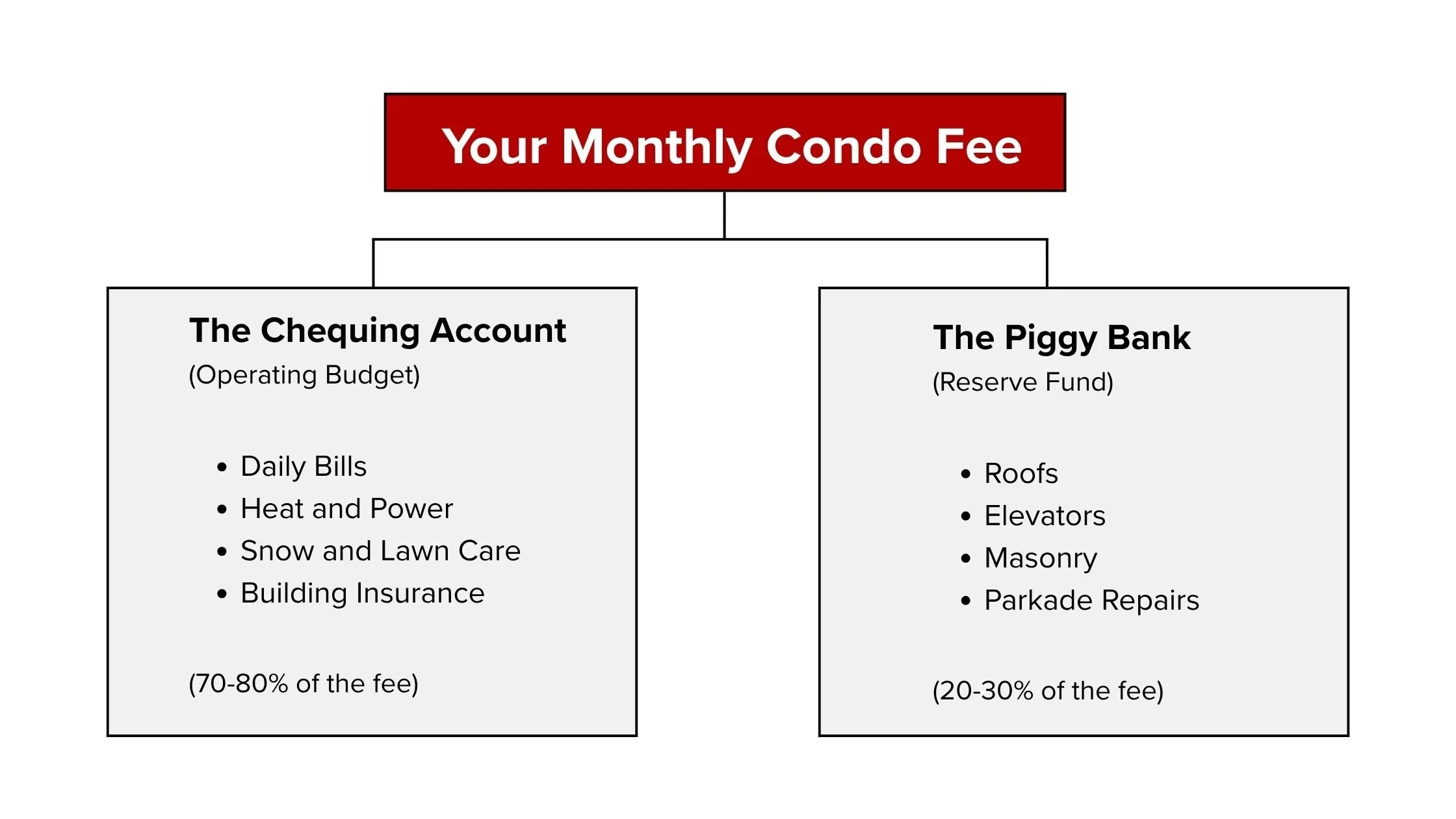
Bucket 1: The Daily Checking Account (The Operating Budget)
This pays for the everyday stuff keeping the lights on this year. It covers the property manager, the snow plow, lobby cleaning, and power for the hallways. Roughly 70% to 80% of your monthly fee goes here.
Bucket 2: The Building's Piggy Bank (The Reserve Fund)
This is long-term savings. By Nova Scotia law, every condo corporation must save money for massive repairs down the road. Think of it as a mandatory retirement fund for the building. When the roof needs replacing in 10 years, the money comes out of this piggy bank—not your personal wallet. Roughly 20% to 30% of your fee goes here.

Line-by-Line: Where Does the Money Actually Go?
While every building in HRM is a little different, here is what a typical Halifax condo fee is paying for behind the scenes.
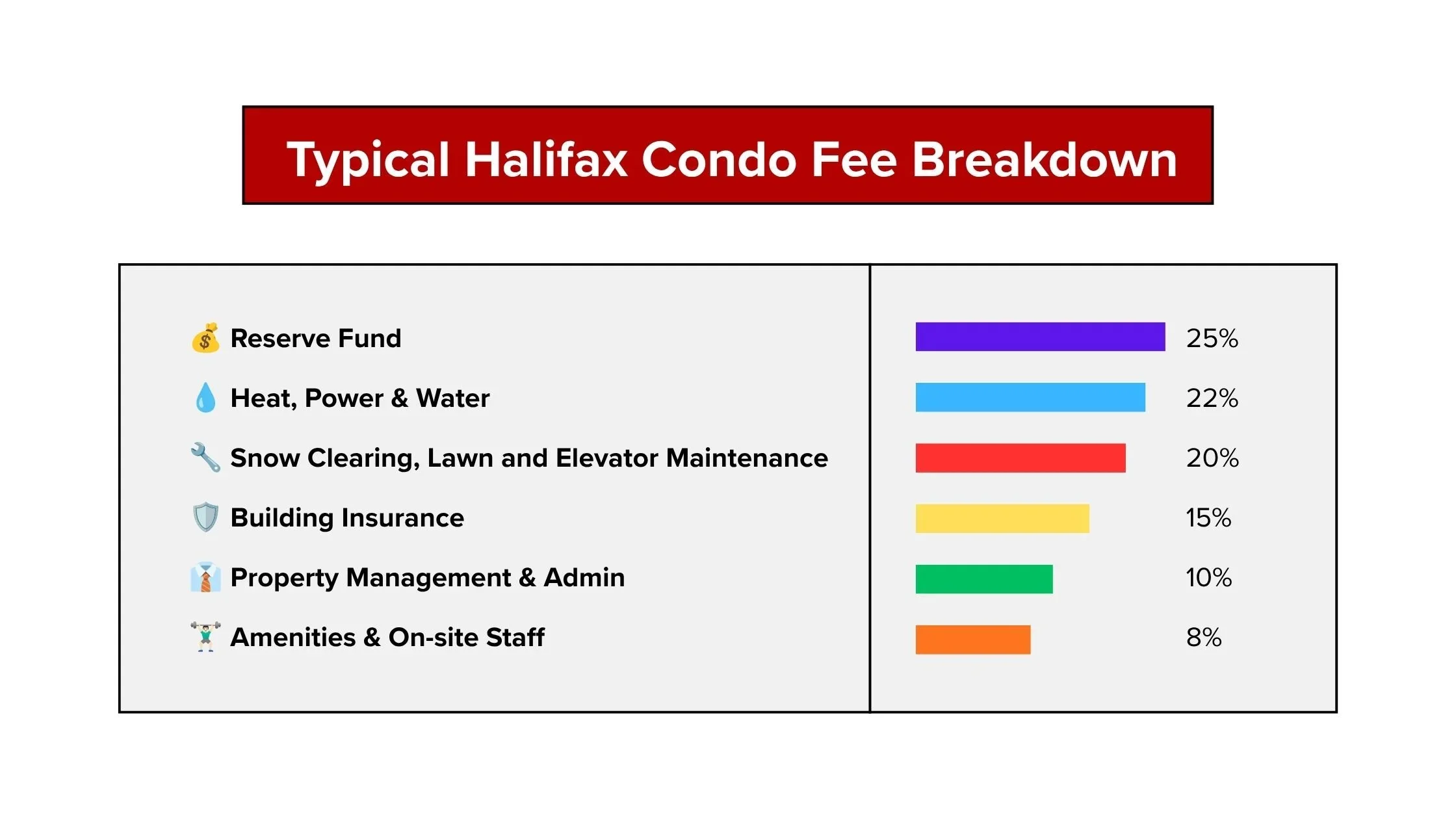
1. Utilities: Heat, Power & Water (20% – 30%)
Utility inclusions vary building by building in Halifax, which is why checking the fine print on a listing is so important:
Heat & Hot Water: In buildings where heat and hot water are included in the condo fee, the monthly fee will look higher on paper, but your personal power bill will be significantly lower. In buildings where owners pay for their own heating (whether through electric baseboards, heat pumps, or gas), the monthly condo fee is usually lower, but you'll pay your utility provider directly each month.
Water & Sewage: Many condo communities cover water and sewer charges through a single master bill paid out of common fees, while others sub-meter water so each owner pays for their own actual usage.
Common Area Power: Regardless of how in-unit power is billed, your fee always covers the electricity needed to heat, cool, and light shared spaces like lobbies, hallways, parkades, and fitness rooms.
2. Atlantic Canada Weather & Repairs (18% – 25%)
Halifax weather is chaotic. We get freeze-thaw cycles, slush, ice storms, and salt air.
Your fee hires professional commercial plows to clear visitor parking, salt the icy parkade ramp before you drive to work at 7:00 AM, and shovel the sidewalks to clear-pavement standards. It also covers routine hallway cleaning, window washing (including the brave souls dangling on ropes for multi-story glass), and regular safety servicing for the elevators.
3. Building Insurance (12% – 18%)
The condo corporation carries a massive insurance policy that covers the entire physical structure: the concrete, exterior walls, roof, elevators, and lobby.
Because your condo fee covers the big stuff, your personal condo insurance (called an HO-6 policy) is surprisingly cheap: usually just $30 to $60 a month, because you only have to insure your own furniture, clothes, and interior finishes.
4. The Rainy-Day Reserve Fund (20% – 30%+)
This is the most important line item on the sheet. Every 5 years, an engineer inspects the entire building and writes a report forecasting when major components will wear out.
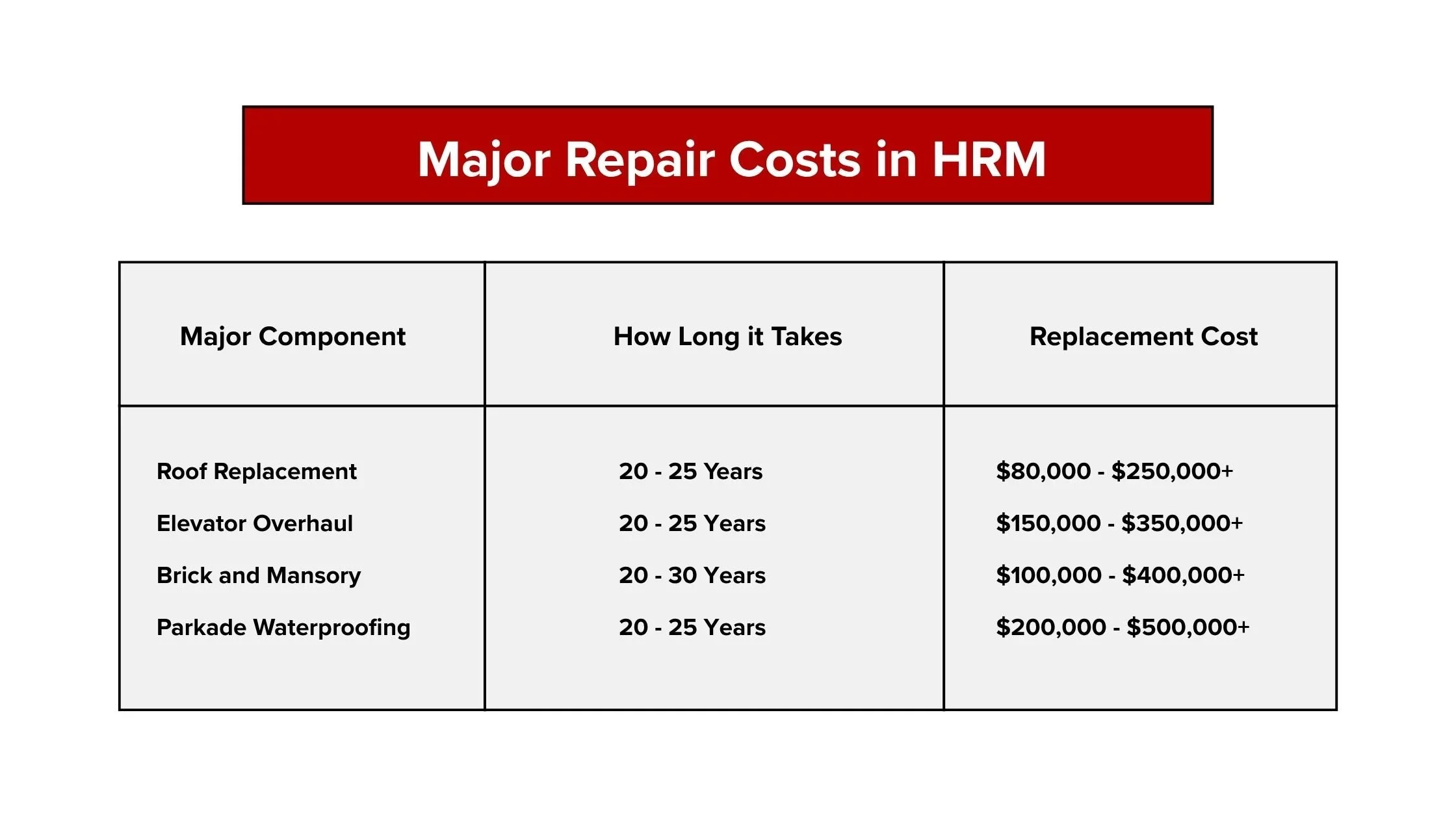
Instead of surprising you with a $20,000 bill out of nowhere when the roof fails, the building collects a small slice of that total from you every single month. When the time comes to fix it, the money is already sitting in the bank.
5. Property Management & Professional Fees (8% – 12%)
Unless it’s a tiny 4-unit building where the owners do everything themselves, most Halifax condos hire a professional management company. They take care of the headaches you don't want to deal with:
Taking emergency maintenance calls at 2:00 AM when a pipe bursts.
Hiring and supervising contractors.
Paying building bills and balancing the books.
Hiring lawyers and accountants to perform annual audits.
6. Amenities & Perks (5% – 10%)
If your building has a heated underground parkade, an indoor pool, a rooftop patio with ocean views, a gym, or an overnight concierge, part of your fee maintains those features. No amenities? Your fee goes down accordingly.

Why Do Two Condos in Halifax Have Completely Different Fees?
You might look at a 2-bedroom condo in Clayton Park charging $450/month, and another 2-bedroom in Downtown Halifax charging $750/month. Why the huge gap?
What’s Included? Always check the fine print. A $750 fee that includes unit heat, hot water, underground parking, and a gym is often cheaper overall than a $450 fee where you pay $250/month for electric heat separately.
Age of the Building: Older buildings simply need more upkeep and higher reserve savings than brand-new builds.
Number of Neighbours: A 120-unit building splits the cost of elevator servicing among 120 wallets. A 10-unit building splits that exact same service bill among only 10 wallets.
Unit Size: Condo fees are calculated by square footage. Bigger units pay a larger percentage of the total budget.
A 600 sq. ft. 1-bedroom pays $390/month
A 1,200 sq. ft. 2-bedroom pays $780/month

Red Flags vs. Green Flags: Spotting a Healthy Condo
When you're out looking at condos with your agent, keep an eye out for these quick warning signs and positive clues:
🚩 Red Flags (Proceed with Caution)
Unusually Low Fees in an Older Building: If a 40-year-old building only charges $250/month, be careful. They might be keeping fees artificially low by ignoring needed repairs. This often leads to a Special Assessment: a sudden, mandatory bill where every owner has to hand over thousands of dollars in cash on short notice.
Wild Fee Spikes: A history of fees jumping 20% year after year means poor planning.
An Empty Piggy Bank: A Reserve Fund balance that is way below what the engineering study recommends.
❇️ Green Flags (Signs of a Great Building)
Predictable, Small Increases: A building that raises fees by 3% to 5% every year is being managed responsibly to keep up with inflation.
A Full Piggy Bank: Plenty of cash set aside in the Reserve Fund for future projects.
Clear Financial Records: Transparent financial reports that clearly explain where every dollar goes.

The Bottom Line
A condo fee isn't an extra tax designed to drain your bank account—it’s just house maintenance bundled up into one predictable, hassle-free payment.
When you're shopping for a condo in Halifax, don't just look at the listing price. Look at the whole picture:
Your Real Monthly Cost = Mortgage + Condo Fee + Property Tax + Power Bill
Work with a local real estate agent who knows how to read condo financial statements, check the reserve fund studies, and verify that the building you love is as financially healthy on the inside as it looks on the outside.

Thinking About Making a Move?
Whether you're looking for a low-maintenance home on the Peninsula, a trendy spot in Dartmouth, or a cozy suburban layout in Bedford, Perkins Real Estate is here to help you navigate the market with confidence.
Get in touch with us today to start your search!
Author: Jordan Gunn
Real Estate Assistant
Perkins Real Estate
Keller Williams Select Realty